
Knowledge Graph: Your Infrastructure as a Living Map
How Hermeez transforms cloud resources and relationships into a traversable, queryable graph.
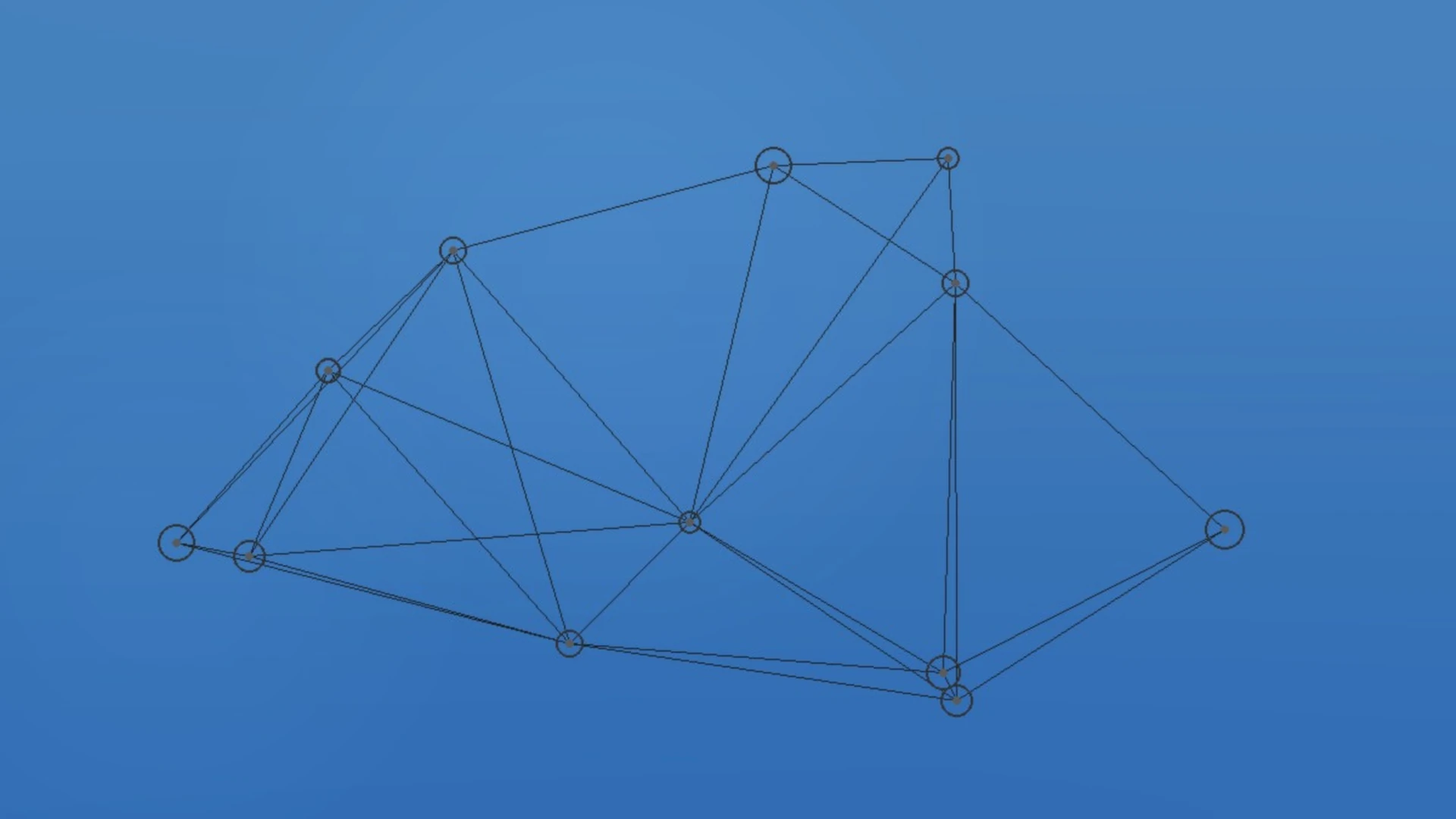
At the core of Hermeez is a continuously updated knowledge graph that represents your cloud infrastructure as a network of entities and relationships. Every EC2 instance, S3 bucket, IAM role, security group, Kubernetes pod, and network path is modelled as a node or edge in a traversable graph. The global knowledge graph market is growing from $1.18 billion in 2024 toward $6.93 billion by 2030 — a 36.6 percent CAGR driven by enterprise AI adoption. This graph is not a diagram or a visualization — it is a live, queryable data structure that powers every insight the platform delivers.
Why graphs, not lists
Traditional cloud management tools operate on flat inventories — lists of resources grouped by service or region. With the average organization now using 3.4 to 4.8 different cloud providers and 89 to 92 percent of enterprises running multi-cloud strategies, these inventories span an enormous surface area. But this flat approach fundamentally limits the questions you can ask.
You can ask "how many EC2 instances do we have?" or "which S3 buckets are public?" but you cannot easily ask "which internet-facing services can reach this database through any combination of network paths and permissions?" A knowledge graph removes those limits. Relationships are first-class citizens: an IAM role assumes another role, which has a policy that grants access to a bucket, which contains objects classified as PII. This chain is a path in the graph, and answering questions about it is a traversal, not a multi-console investigation.
Real-time ingestion and reconciliation
The graph ingests data from AWS, Azure, and GCP APIs, Kubernetes control planes, identity providers, CI/CD pipelines, and DNS records. With 82 percent of container users now running Kubernetes in production according to the CNCF's 2025 survey, and 98 percent of surveyed organizations having adopted cloud-native techniques, the graph must span an increasingly complex and dynamic landscape.
It reconciles state across providers in real time, detecting drift, orphaned resources, and configuration inconsistencies as they occur rather than during periodic scans. When a developer creates a new security group rule, the graph updates within seconds. When a Terraform apply adds a new service, the graph models it before the first request hits the load balancer.
Contextual findings by default
Every AI agent in Hermeez operates on this shared graph, which means findings are contextual by default. A security vulnerability is not just a CVE number — it comes with the full blast radius: which services are affected, what data is reachable, and how an attacker could chain it with other weaknesses. Wiz's research found that 35 percent of cloud environments have instances that both expose sensitive data and have high or critical vulnerabilities — but the critical question is which of those combinations create exploitable attack paths. The graph answers that question.
A cost recommendation is not just "this instance is idle" — it includes what workloads depend on the instance, whether it serves as a failover target, and who owns it. A compliance finding is not just "encryption is missing" — it traces every data path that the missing encryption exposes and maps it to the specific regulatory control that requires it. This contextual enrichment is what enables the dramatic MTTR reductions that graph-based systems deliver.
The foundation for infrastructure intelligence
The knowledge graph is not a feature of Hermeez — it is the foundation. Every capability the platform offers, from natural language queries to autonomous agent insights, derives its power from the graph's ability to model and traverse the relationships that define your infrastructure. Without the graph, you have dashboards. With it, you have intelligence.